Category
Service 1
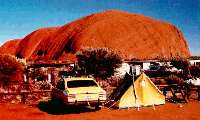
Uluru is a sacred site to the Anangu tribes of Central Australia
A massive sandstone monolith in the heart of the Northern Territory’s arid "Red Centre"


The disappearance of Azaria Chantel Loren Chamberlain on the night of the 17 August 1980 during a family camping trip to Uluru in the Northern Territory. Her body was never found.
"I saw the dingo coming out of the tent, dingo tracks were found around and inside the tent and her blood was found in large quantities, it was on the mattress, on the tent and near the carry-basket she had been sleeping in" "It wasn't me, it was the dingo I could see from the door that she wasn't there. But my mind wouldn't accept it"

The disappearance of Azaria Chantel Loren Chamberlain on the night of the 17 August 1980 during a family camping trip to Uluru in the Northern Territory. Her body was never found. In the Chamberlain case some members of the media were flat liars. As one commentator said, Lindy’s situation was a media dream. It had all the elements: mystery, instinctive fears, motherhood, femininity, family, religion, politics, and tourism, combined with court and forensic drama.
“If I smiled, I was belittling my daughter’s death,” “If I cried, I was acting.”

The story became notorious and news articles surfaced the media. Depending on the survey, some 70% of Australia’s public believe Lindy is innocent of murder, and that a dingo was responsible. The remaining 30% most commonly respond that they know she is guilty, on the basis of discredited interpretation of the evidence – perhaps they have still not got the message. Their strongest belief is that she got away with it because she ‘had good lawyers.’ But during the trial, it was 70% who believed she was guilty, and 30% not guilty
“If I smiled, I was belittling my daughter’s death,” “If I cried, I was acting.”
Category
Uluru is a sacred site to the Anangu tribes of Central Australia
A massive sandstone monolith in the heart of the Northern Territory’s arid "Red Centre"

Category
The Azaria Chamberlain case is a reminder that the criminal justice system does get it wrong, with each error bearing its own human cost. Lindy Chamberlain-Creighton was tried and found guilty of the child’s murder in one of the most public criminal cases in Australian history. She was sentenced to life in prison and served nearly three years before new evidence and a Royal Commission Inquiry led to a pardon and reversal of her wrongful conviction.

17 August 1980
Nine-week-old Azaria Chamberlain, was taken by a dingo from a camping ground near Ayers Roc

Stephen A. Russell
Ngarigo man and contemporary artist Peter Waples-Crowe has created various artworks of dingoes after the lindy chamberlain case. Indigenous Mythology dingoes are believed to live in the physical and spiritual realms, and considered valuable camp guardians due to their ability to perceive evil spirits that are undetectable by man.